
A Little Life, A Big Battle: The Story of a Child’s Liver Transplant in Nepal
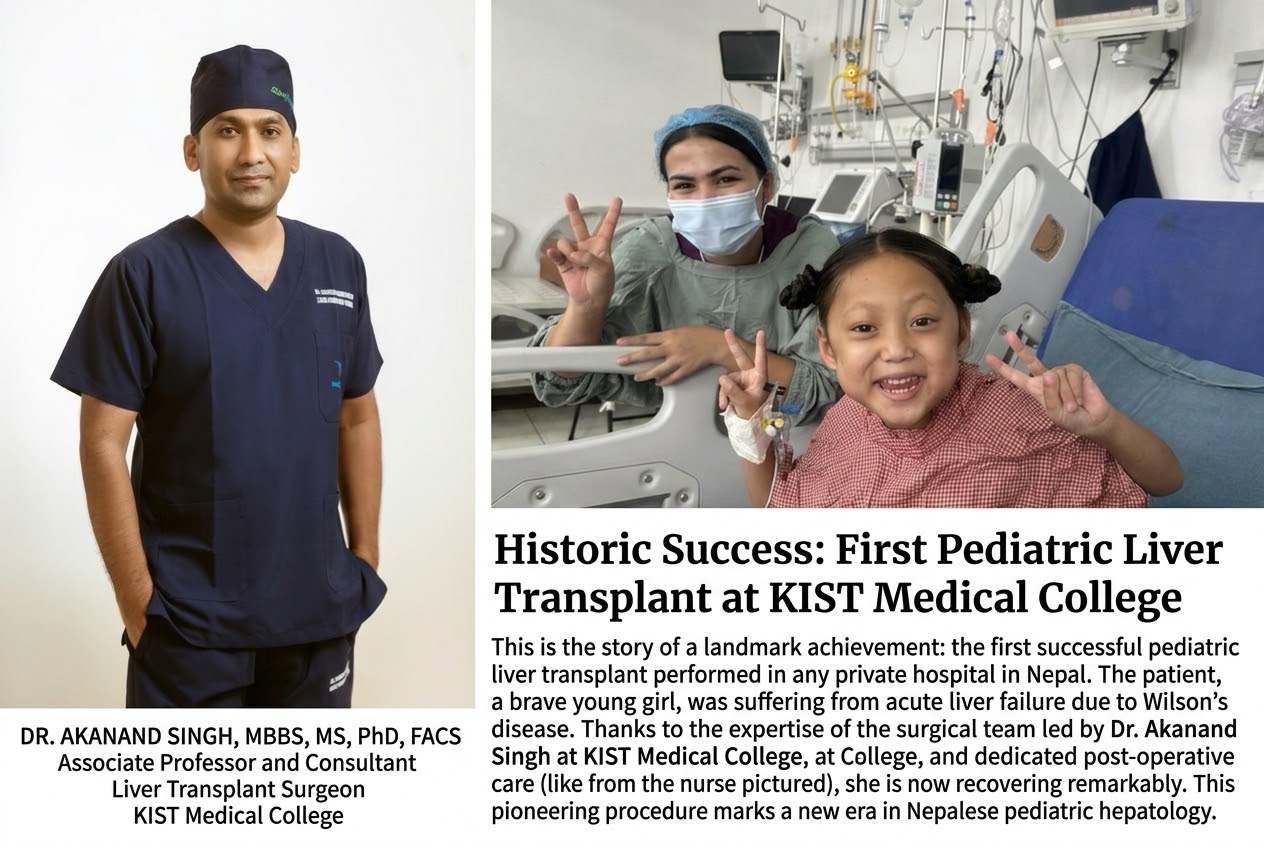
How multidisciplinary teamwork, a mother’s sacrifice, and the determination to overcome challenges gave a five-year-old girl with Wilson’s disease a new chance at life.
When Liver Transplantation Became the Only Hope
At just 5 years and 5 months of age, a little girl was fighting a battle no child should have to face. Diagnosed with Wilson’s disease, a genetic disorder that causes copper to accumulate in the body, she had been receiving medical treatment under the care of a pediatrician at Kanti Children’s Hospital in Kathmandu.
Despite medical management, her condition continued to deteriorate. She developed ascites, resulting in abdominal swelling, along with hepatic encephalopathy, weakness, and mild jaundice. These were signs of advanced liver disease, and her condition was becoming increasingly critical.
At that stage, liver transplantation was the only potentially life-saving treatment option.
However, finding a suitable transplant center and arranging the complex medical care required for a small child proved to be another major challenge for her family.
A Family Searching for Hope
Before reaching us, the child’s parents had approached several hospitals in Kathmandu in search of a solution.
According to the family, they first visited Tribhuvan University Teaching Hospital (TUTH), where they were informed that pediatric liver transplantation was not being performed there. They subsequently approached the Shahid Dharmabhakta National Transplant Center (SDNTC) in Bhaktapur. However, the lack of dedicated pediatric care facilities made it difficult to arrange the necessary inpatient management before transplantation.
With limited options and a critically ill child, the family eventually came to meet me, Dr. Akanand Singh, at KIST Medical College Teaching Hospital.
We had not performed a pediatric liver transplant at our center before. Nevertheless, we understood the urgency of the situation and the importance of exploring every reasonable opportunity to save this young life.
We knew the undertaking would be challenging. A liver transplant in a small child with advanced liver disease requires careful planning, experienced surgical expertise, and close coordination across multiple medical specialties.
But we also knew that the child deserved a chance.
Building a Team Around One Child
The decision to proceed required much more than a surgical plan. It required a hospital-wide commitment.
We organized multiple multidisciplinary team meetings involving specialists and professionals from pediatrics, hematology, critical care, anesthesiology, nephrology, dialysis services, nursing, transplant coordination, and hospital administration.
Every aspect of the child’s care needed careful consideration, including the management of hepatic encephalopathy, donor evaluation, perioperative support, critical care facilities, and postoperative recovery.
Meanwhile, the child remained in hospital for an extended period as the family struggled to identify a suitable living liver donor.
Time was precious, and the search for a donor became one of the most difficult parts of the journey.
The Search for a Suitable Liver Donor
Initially, we began evaluating the child’s mother as a potential living liver donor. Unfortunately, her liver assessment revealed fatty liver disease. Her body mass index (BMI) was also approximately 34, making further evaluation and optimization necessary before she could safely donate.
We explained the findings and discussed the available options with the family. The child’s father then came forward to be evaluated as a potential donor. However, his investigations revealed that he also had Wilson’s disease, making him unsuitable for donation.
Once again, the family faced uncertainty.
With the father excluded as a donor and the mother requiring further optimization, we had to reconsider our options carefully. The mother’s health and safety were just as important as the child’s urgent need for transplantation.
Following detailed evaluation and counselling, we initiated a supervised medical and lifestyle optimization plan for the mother. Over the following four weeks, her liver assessment improved, and her BMI decreased from approximately 34 to 29. This allowed us to proceed with further donor assessment and planning for transplantation.
Her willingness to undergo this process reflected the extraordinary commitment of a mother determined to give her child another chance at life.
Living donor liver transplantation always requires a careful balance: saving the recipient while protecting the donor. In this case, that principle guided every step of our decision-making.
Preparing for Our First Pediatric Liver Transplant
As this was the first pediatric liver transplant at KIST Medical College Teaching Hospital, we wanted to ensure that every possible precaution was taken.
We invited an experienced liver transplant team from Indraprastha Apollo Hospital, New Delhi, led by Dr. Neerav Goyal, to collaborate with us during this complex procedure.
Their experience and expertise were invaluable as we prepared for the operation. Our objective was clear: to provide the child with the safest possible care through collaboration, meticulous preparation, and shared expertise.
However, arranging international clinical collaboration in Nepal involved an additional administrative challenge.
Foreign medical experts participating in such procedures must obtain the appropriate temporary licensing and approval from the Nepal Medical Council (NMC). The application process involves advance submission, consideration by the relevant committee, an interview, and the subsequent issuance of a temporary licence.
Although these regulatory safeguards are important, the process can create significant logistical difficulties when a critically ill patient requires urgent treatment. In this case, the child already had Grade II hepatic encephalopathy, making timely coordination particularly important.
We worked through the necessary administrative procedures while continuing to monitor and manage the child. Fortunately, we obtained the required approval in time and were able to proceed before further deterioration prevented transplantation.
This experience reinforced an important lesson: complex, time-sensitive medical care requires both strong clinical systems and efficient regulatory coordination.
The Day of Surgery: A New Chance at Life
After a month of preparation, donor optimization, multidisciplinary planning, and coordination with the visiting team, the day of surgery finally arrived.
The living donor liver transplantation proceeded without any major intraoperative complications.
For the family, it was the culmination of an exhausting period filled with uncertainty, financial strain, and hope. For our team, it was the result of a month of preparation, collaboration, and shared responsibility.
The operation marked an important milestone for our transplant program, but the real measure of success would be the recovery of both the child and her mother.
Recovery: Two Lives Moving Forward
The postoperative course brought encouraging news.
The mother, who had undergone donor hepatectomy, recovered well and was discharged on the seventh postoperative day.
Her daughter continued to recover under close medical supervision and was discharged on the seventeenth postoperative day.
Both recoveries were deeply encouraging for everyone involved.
The family had already spent a substantial amount on treatment at different hospitals and during the prolonged course of care at KIST Medical College Teaching Hospital. Financial support from well-wishers and donations also helped them navigate this difficult period.
Their journey was a reminder that life-saving treatment often requires not only medical expertise but also family commitment, community support, and a healthcare system capable of bringing these resources together.
Two Months Later: A Story of Hope
It has now been two months since the transplant, and the child is doing well. Her family is relieved and grateful to see her recovering and moving forward after such a difficult period.
For a child who had been struggling with advanced liver disease, this represents a new opportunity for growth, development, and childhood.
For her mother, it is also a remarkable journey: she underwent careful medical optimization, became an eligible donor following reassessment, and ultimately gave her daughter a chance at life.
Their story is not simply about a successful operation. It is about what can happen when families, medical professionals, institutions, and supporters work together toward a common goal.
Lessons for Pediatric Liver Transplantation in Nepal
This case highlights several important issues in the development of pediatric liver transplantation in Nepal.
- Timely access to transplantation matters.
Children with advanced liver disease may deteriorate rapidly. Early referral to a center capable of assessing and managing pediatric liver transplantation can be crucial.
- Multidisciplinary care is essential.
Pediatric liver transplantation requires coordinated expertise across surgery, pediatrics, anesthesia, critical care, nephrology, nursing, and other supporting services.
- Living donor evaluation requires patience and careful judgment.
A potential donor may need further assessment or medical optimization. Donor safety must never be compromised by the urgency of the recipient’s condition.
- Collaboration strengthens local capacity.
Working with experienced international transplant teams can help local institutions manage complex cases, develop expertise, and strengthen transplant services.
- Administrative processes should support timely, safe care.
Appropriate credentialing and licensing are essential. At the same time, clear and efficient pathways for urgent specialist collaboration could help hospitals respond more effectively to complex medical emergencies.
- Financial support can make a meaningful difference.
For families facing prolonged hospitalization and major surgery, community contributions and compassionate support can help make otherwise difficult treatment journeys possible.
A Message of Gratitude
As a hepatobiliary and liver transplant surgeon, I believe that the true value of our work lies not only in performing an operation but also in giving patients and their families renewed hope.
I am deeply grateful to the entire team at KIST Medical College Teaching Hospital, including our pediatricians, anesthesiologists, critical care specialists, hematologists, nephrologists, dialysis team, nursing staff, transplant coordinators, and hospital administration.
I also extend my sincere appreciation to Dr. Neerav Goyal and his team from Indraprastha Apollo Hospital, New Delhi, for their collaboration and support during this landmark case.
Above all, I salute the courage of this little girl, the determination of her parents, and the generosity of everyone who supported the family during their difficult journey.
A successful liver transplant is never the achievement of one surgeon alone. It is the result of teamwork, trust, preparation, and a shared commitment to saving lives.
For this little girl and her family, the transplant has opened the door to a new chapter.
One child. One mother’s extraordinary gift. One team’s collective effort. And a future filled with hope.